
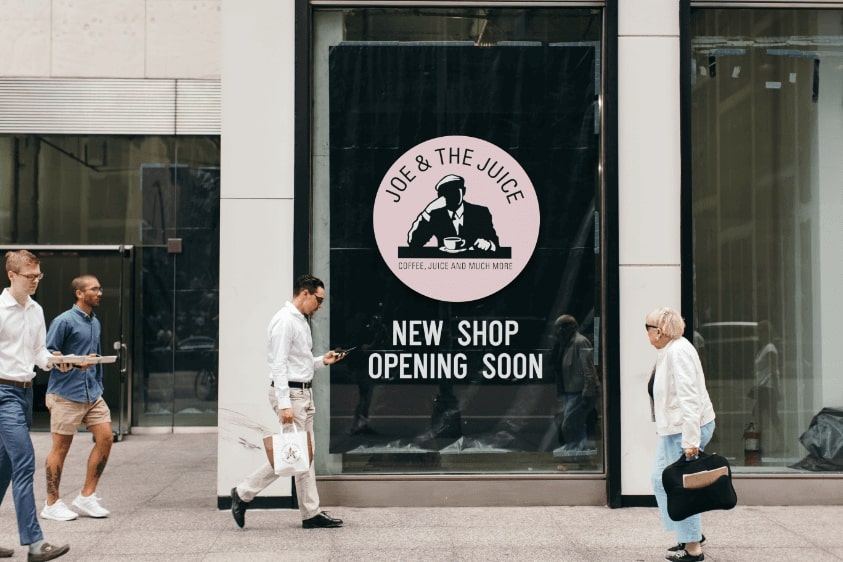
Patience, Then Partners: The Joe & the Juice Growth Story
Joe & the Juice was founded in 2002 by Kaspar Basse, a former Danish karate champion, in a small juice counter inside a Copenhagen clothing store. A regular customer, Philip "Pippo" Finsteen, once covered a shift and tripled the day's sales through sheer personality — cementing Basse's belief that staff charisma, not just product, would differentiate the brand. That belief was formalized in 2019 through a codified set of internal brand principles, and the tension behind it was documented in real time: a 2017 Harvard Business School case on the company's US expansion centered on Basse's concern for preserving frontline meaning at scale, citing a strict promote-from-within policy and a deliberately unscripted customer experience.
Expansion followed a patient, staged regional logic rather than an early rush abroad. Denmark and the Nordics anchored the company's earliest years, with the UK becoming its first international test in 2009, seven years after founding. By the time Valedo Partners invested in 2013, the company had grown to roughly 50 stores in total. The Netherlands followed in 2018, and more recently France and Benelux. The US, entered in 2015 via a first store on Spring Street in SoHo, became the largest market overall by 2024, with New York alone now holding roughly 38% of all US locations. The Middle East arrived later still — 2022, twenty years after founding — built through local franchise partners across six countries and passing its 100th franchise store in 2025, a pace of growth that stands out even if it doesn't yet outrun the company's more established markets in absolute terms. Australia, entered in 2016, was exited in 2023 to focus on core growth markets.
This is, at its core, a private equity expansion roadmap, executed in three funded stages, each investor bringing a specific capability the company didn't yet have. Valedo Partners, the Swedish growth-equity firm that took a stake in 2013, has a strong hand at this: its portfolio has produced six IPOs, including Nordic consumer names Better Collective and BEWI, with exited businesses growing roughly 300% on average during its ownership. The effect on Joe & the Juice was immediate and stark — the company grew from 50 to 175 stores within three years of Valedo's investment, the clearest inflection point in its history. General Atlantic, whose own portfolio includes the Airbnb and Uber IPOs, entered as a minority investor in 2016 and took full majority control in 2023 for a reported $641 million, while cutting net leverage to roughly 1x EBITDA.
Leadership evolved through three distinct chapters rather than one clean handover. Basse stepped down as CEO in 2019 in favor of Sebastian Vestergaard, who had joined the company as a frontline "juicer" in 2004 and risen through the ranks over the years — a genuine internal succession. Vestergaard stepped down in 2021, and Thomas Nørøxe, who combined prior investment banking and private equity experience with eighteen months as the company's own Chief of Staff, took over as CEO — a position he still holds today. Governance sharpened further in April 2025, when Jeffrey Lawrence — a General Atlantic senior advisor and former Domino's Pizza CFO who helped lead that company's own 2004 IPO and international buildout — was named Chairman. A year later, Emirates International Investment Company (EIIC), the Abu Dhabi-based arm of National Holding, acquired a roughly 4% stake at a $1.8 billion valuation. EIIC brings a specific, demonstrated track record in exactly the region Joe & the Juice is scaling into through franchising: it was a cornerstone investor in Talabat's 2024 Dubai listing, the largest technology IPO in the GCC that year, alongside stakes in National Holding's own Lulu Hypermarket and hospitality portfolio.
The financial results track this progression closely: 2024 revenue reached DKK 2.8 billion (+17%), and newly published 2025 results show DKK 3.3 billion (+16.5%), with EBIT up 19% and same-store sales up 6% across every region. Digital ordering has grown into a meaningful part of the business alongside physical expansion, a channel the company has continued to invest in as it scales. The company now runs roughly 485 stores across 23 countries, targeting 1,000 by 2028.
The ownership path stands out further against how two notable competitors have scaled. Jamba Juice, founded in San Luis Obispo, California in 1990 and built almost entirely around the US market, took the opposite structural route: after decades oscillating between company-owned and franchised stores, it went public via a 2006 SPAC merger, was taken private again in 2018 by Roark Capital for $200 million, and now operates almost entirely through franchisees under Roark's GoTo Foods platform — growth through licensing rather than direct control, and largely confined to a single country. Pret A Manger, founded in London in 1986 and still UK-headquartered with the US as its other major market, offers the closer parallel: Bridgepoint Private Equity bought it in 2008 for roughly £350 million and sold it to JAB Holding in 2018 for £1.5 billion, a return of more than 4x over a decade, and JAB is now itself weighing new investors ahead of a possible IPO — nearly the same staged sequence Joe & the Juice is currently running, one investor generation behind.
The Road Ahead
Observing Joe & the Juice's growth journey in the making offers genuinely interesting takeaways for any food and beverage market observer. The company spent its first seven years building a deep, disciplined foundation across Denmark and the Nordics, and that groundwork paid off the moment specialized private capital arrived in 2013: growth from 50 to 175 stores within three years, the clearest inflection point in the company's history. Each investor since has brought a distinct capability rather than simply capital — Valedo's Nordic operating discipline, General Atlantic's global growth capital and governance, and now EIIC's Gulf retail network arriving alongside the company's franchise push into that region. With Jeffrey Lawrence's governance experience and EIIC's regional network now part of the story, there's real reason to look forward to what their footprint brings to the company's next chapter. Pret A Manger and Jamba Juice both show that a strong consumer brand can reach the finish line through more than one route — a public listing, a fully franchised platform, or something else entirely — and Joe & the Juice's own path, built one deliberate partnership at a time, is a genuinely compelling one to keep following as it writes its next chapter.
Source: joejuice.com · generalatlantic.com · valedopartners.com · eiic.ae · hbs.edu (Rouen & Srinivasan, 2017) · en.wikipedia.org