
Reimagining Healthcare: The Neko Health Growth Story
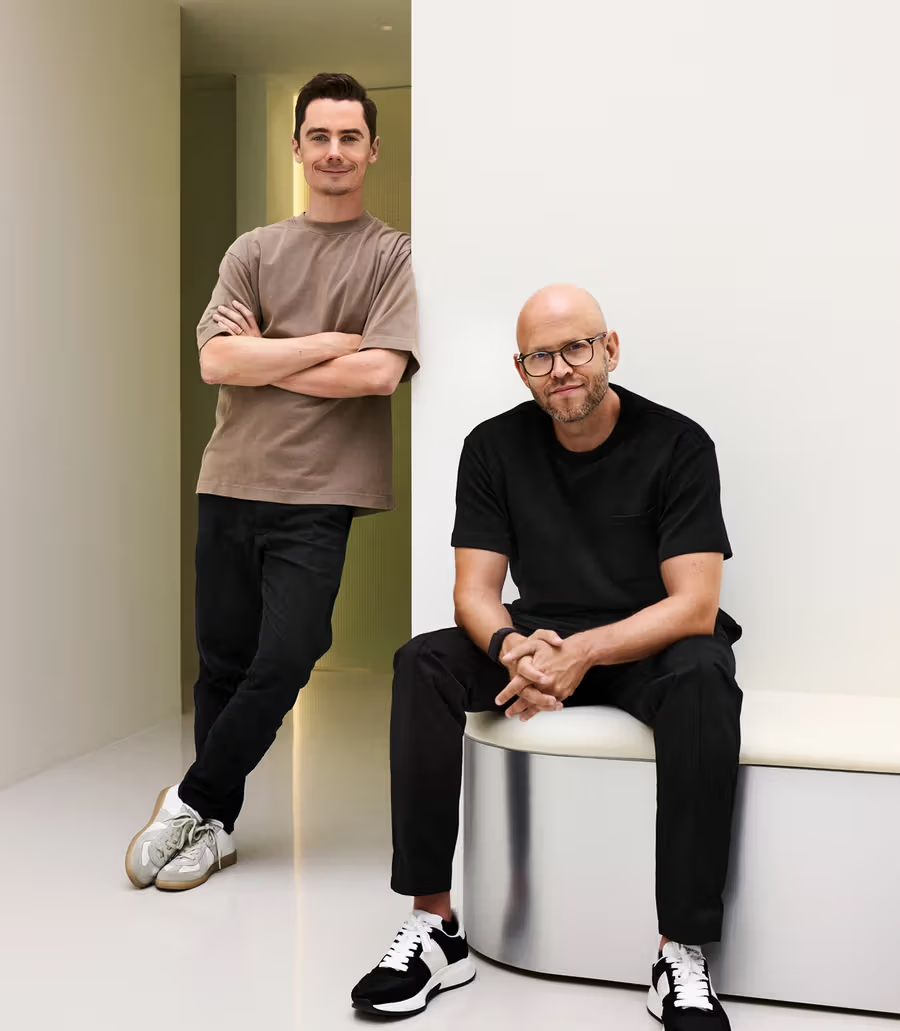
Neko Health got its start with a big question. In 2018, Daniel Ek — fresh off Spotify's own direct listing that year — messaged Hjalmar Nilsonne over Twitter to ask what healthcare would look like if someone designed it from scratch today, rather than inheriting a system built half a century ago. Nilsonne, an industrial engineer from KTH Royal Institute of Technology who came from a family of doctors, was running an energy-monitoring startup at the time. The two spent months in discussion before deciding to build the answer together, spending four years in stealth research and product development before Neko launched publicly in Stockholm in February 2023.
The company's core bet was mechanical as much as medical: rather than relying on MRI scanning, the technology most of its eventual competitors would build around, Neko developed its own proprietary sensor and imaging hardware, controlling its full stack from cameras to software to the clinics themselves. The scan itself takes under an hour, covering cardiovascular, metabolic, and skin health, and ends with an in-person consultation the same day. That control extends to manufacturing as well as design: all four of its proprietary devices are engineered and physically assembled in Stockholm, where clinical researchers and hardware engineers share the same floor — a level of vertical integration unusual even among well-funded health-tech hardware companies, most of which lean on contract manufacturers. Around its Series B, the company acquired a sensor startup to strengthen its data-capture capability, one of several moves accelerating its technology roadmap alongside its own in-house development.
Expansion has followed a measured, capital-timed sequence. Stockholm carried the company through its first year and a half. London became its first market outside Sweden in September 2024, followed by Manchester and Birmingham. New York, opened in September 2026 at a flagship SoHo location, is the company's first US market, with Miami, Washington D.C., and San Francisco already planned to follow within the year.
Capital arrived in three distinct stages, each roughly doubling the company's ambition. A $65 million Series A closed in July 2023, led by Lakestar with Atomico and General Catalyst, alongside Prima Materia — Daniel Ek's own investment firm. Eighteen months later, in January 2025, Lightspeed Venture Partners led a $260 million Series B at a $1.8 billion valuation, with Lightspeed's Bejul Somaia joining Neko's board — a governance step that mirrors how other fast-scaling Nordic companies have brought in specialized board expertise alongside capital. By July 2026, an even larger $700 million Series C, again led by Lightspeed alongside O.G. Venture Partners, pushed the valuation to roughly $7 billion, with a notably prominent list of individual backers including Mark Zuckerberg, Maria Sharapova, and Tim Ferriss. Headcount has grown roughly tenfold over the same period, from an estimated 74 employees in 2023 to more than 600 by mid-2026, with estimated revenue of $22+ million in 2025.
Neko entered a market it didn't create alone. Prenuvo and Ezra, its two most direct American competitors, were both also founded in 2018 — a striking timing of three companies converging on the same insight the same year, through different technical routes. Prenuvo, based in Redwood City, California, built the largest dedicated whole-body MRI network in the category, operating more than 24 owned clinics and completing over 170,000 scans to date. Ezra, New York-founded and now part of the celebrity-backed Function Health platform following a 2025 acquisition, took the opposite infrastructure approach: rather than owning clinics, it partners with more than 100 independent imaging centers, trading consistency for faster geographic reach. Neko's distinction is structural rather than incremental: owning its entire technology stack, rather than depending on MRI equipment and infrastructure it would otherwise share with hospitals or imaging chains, gives it a different cost and control profile than either American rival — a genuine architectural difference.
The Road Ahead
Neko's growth to date is a case study in conviction rewarded: three funding rounds in three years have taken the company from a $65 million Series A to a $7 billion valuation, spanning four markets across two continents, with waitlists at every location long enough to function as their own marketing engine before a single ad is bought. Ek is, in effect, running the same playbook twice — taking a fragmented, analog category and rebuilding it entirely around the user, the same wager that built Spotify, now aimed at diagnostics rather than music. The capital behind that wager is not passive: Lightspeed's board seat and the caliber of individual backers drawn to the Series C both suggest strategic support built to accelerate further geographic expansion and the kind of diagnostic innovation that could push preventive healthcare from a premium niche into a genuine mainstream category — a shift worth watching closely as it unfolds. Where this gets more interesting still is the open competitive question it leaves behind: Neko, Prenuvo, and Ezra are running three distinct architectures on the same underlying idea, and which one proves most scalable, and most trusted, remains a genuinely open contest.
Source: nekohealth.com · techcrunch.com